INCEPTION FINANCIAL SERVICES
Every question costs something. Spend them wisely.
Role: Lead Designer & Builder
Company: Inception Financial Services
Domain: Financial Services · Client Onboarding
Built with: Claude AI • 2026
The Brief
An intake form is a trust transaction. Every irrelevant question is a withdrawal.
Intake forms in financial services carry a weight most designers underestimate. The moment a prospective client opens one, they're forming a judgment — not just about the process, but about the advisor on the other side. A form that asks the wrong questions, or too many of them, signals something: we don't know who you are, and we don't have a system for finding out.
Inception Financial Services specializes in tax-advantaged retirement strategies. Their advisors build sophisticated, personalized plans. But their intake was a flat, static questionnaire — the same 9 sections for every client, regardless of whether they were a single retiree or a married couple with multiple pensions, investment properties, and competing insurance policies. Every client answered every question. Most answered many of them wrong, or not at all.
The brief was to replace an existing pop-up form. What I built was a rethink of what an intake actually is — and how it should behave when it finally knows who it's talking to.
Signal-to-noise failure
Advisors received profiles full of blank fields, N/A entries, and misapplied answers. The form was producing intake volume, not intake quality.
Context blindness
A single retiree and a married couple with a pension, a rental property, and three IRAs were presented with identical questions — zero adaptation for situation.
Wrong container for the moment
A pop-up triggers mid-browsing. A 9-section intake deserves a context that matches its weight — purposeful, focused, and on the client's terms.
Two contexts, one blunt instrument
Website visitors and post-seminar email recipients have fundamentally different intent, trust levels, and devices. The form made no distinction between them.
Reducing cognitive debt and improving data quality are usually in tension. The design challenge was resolving them with the same move.
The Design Decision
The form shouldn't ask less. It should know more.
The instinct on a long, painful form is to cut questions. That's the wrong frame. The questions Inception's advisors need are the right questions — the problem is that the form asked all of them regardless of whether they applied. The fix wasn't subtraction. It was intelligence.
I rebuilt the intake as a chat-style conversational experience with conditional logic mapped to every decision point. The form branches on filing status, employment status, employer type, and asset class. A client who selects "not currently employed" never sees a salary field or an inflation percentage input — income is recorded as $0 automatically. A client filing as an individual never encounters the spouse flow. The logic is invisible; the experience is just shorter, because it stopped wasting their time.
The second design problem was delivery. The form serves two distinct audiences with different starting points: a website visitor who's considering the next step, and a seminar attendee who's already interested and filling this out from their phone in the car. Those aren't the same interaction. I designed for both.
Design principle
Intelligence at the data layer reduces friction at the surface layer. You don't simplify the form — you simplify the experience of the form.
Think of it like the health questionnaire before a doctor's appointment. You don't resent it — because you understand what it's for, and it doesn't ask about your knee when you're there for your shoulder.
The Experience
Four conditional branches that demonstrate the design thinking — each one an answer to a specific failure in the original form:
Employment — Status drives the entire income flow
Select "not currently employed" and income records as $0 automatically — salary fields, inflation rate, and employer questions are suppressed entirely. No blank boxes. No confusion about what to enter. The form already knows the answer.
Filing Status — Single means the spouse path never exists
Choose "Individual (Filing Single)" and the spouse flow doesn't appear — it's not hidden or grayed out. It simply isn't there. Choose "Married/Partnered (Filing Jointly)" and a complete parallel path opens for employment, pensions, assets, and insurance.
Employer Type — A choice, not a blank field
Rather than a freeform "Employer" entry, clients select from structured options. That choice forks into the relevant follow-up questions — pension eligibility, contribution type, projected retirement date — instead of presenting a generic form that can't validate what it receives.
Review Step — Confirm before you send
Before submission, every answer surfaces in a grouped, editable summary. The client can correct any section inline. It reduces anxiety, catches errors — and signals that what they're sending actually matters to someone on the other side.
When AI is the implementation layer, the quality of your thinking — not the speed of your execution — becomes the rate-limiting factor.
Coverage
For married or partnered clients filing jointly, a complete second path runs in parallel — spouse employment, pensions, assets, and insurance. Only when applicable.
Contact & Profile
Employment & Income
Social Security
Pension
Retirement Assets
Additional Assets
Long-Term Care Insurance
Life Insurance
Risk Assessment
Delivery Architecture
One form. Three surfaces. Each one intentional.
Where and how a form appears is part of its design. I made deliberate decisions for each surface — not defaults.
Website (Desktop) — Modal overlay
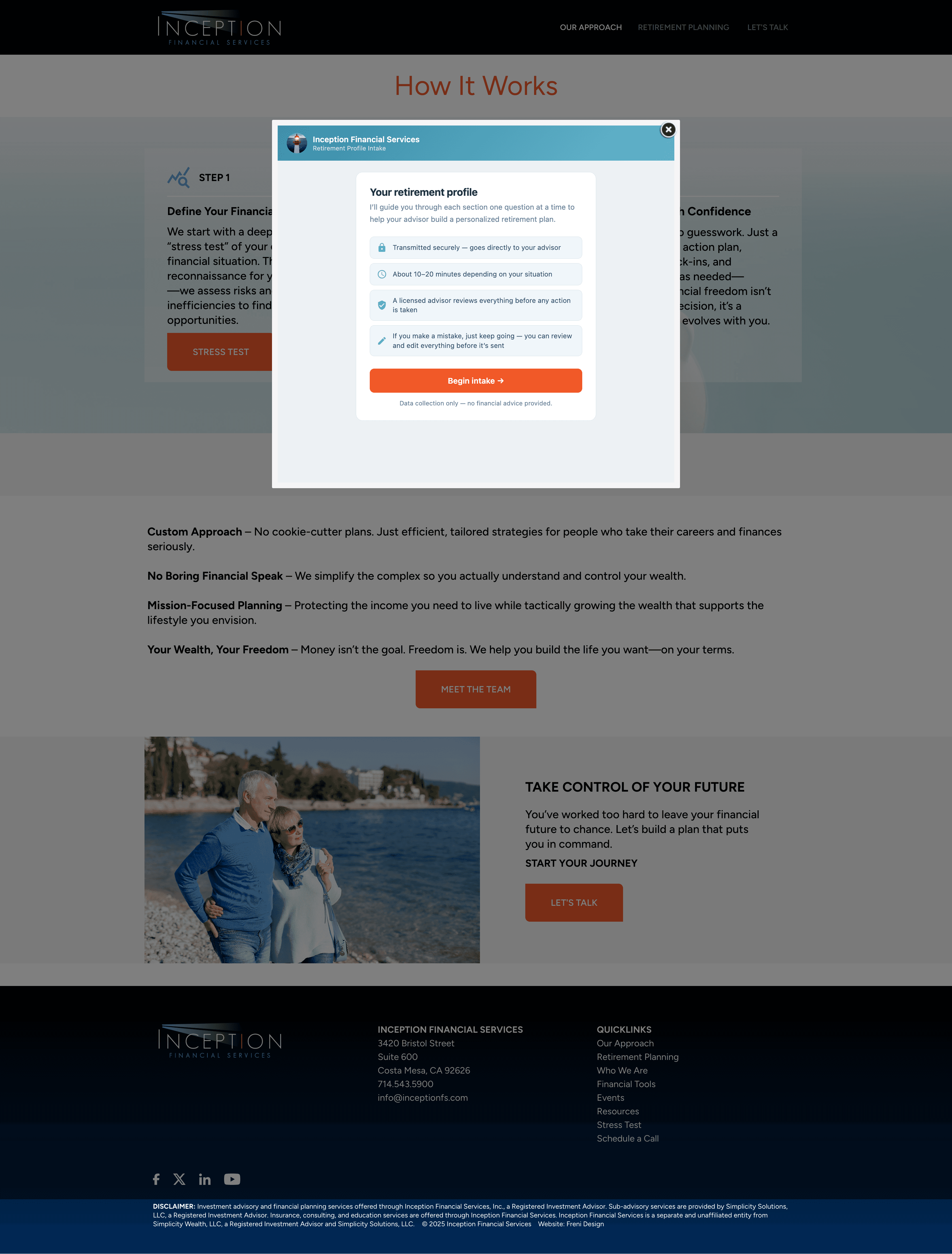
The form opens over the page. The visitor doesn't leave; the context doesn't break. Esc or click outside to dismiss. The advisor's brand stays visible behind it — a deliberate trust signal that this isn't a redirect to somewhere else.
Website (Mobile) — Full-page experience
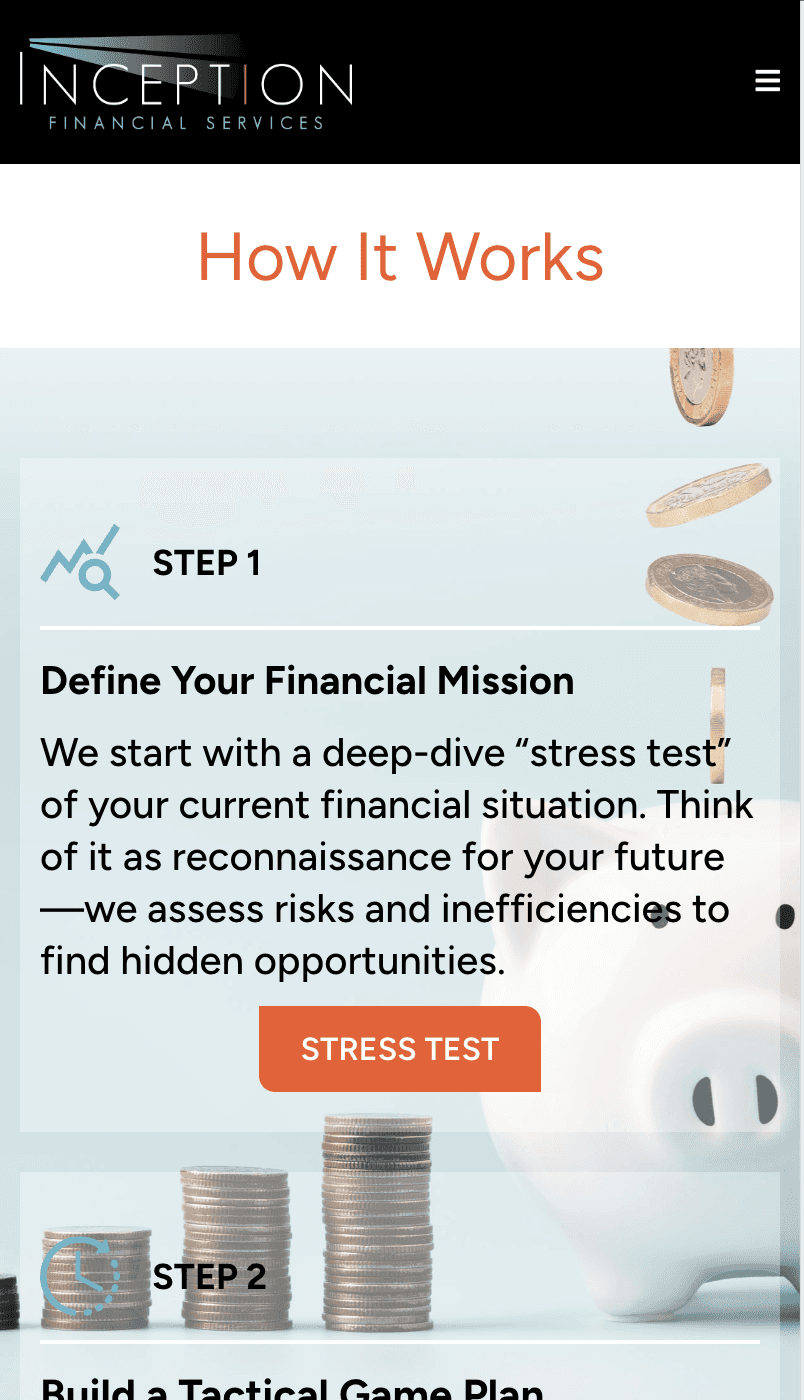
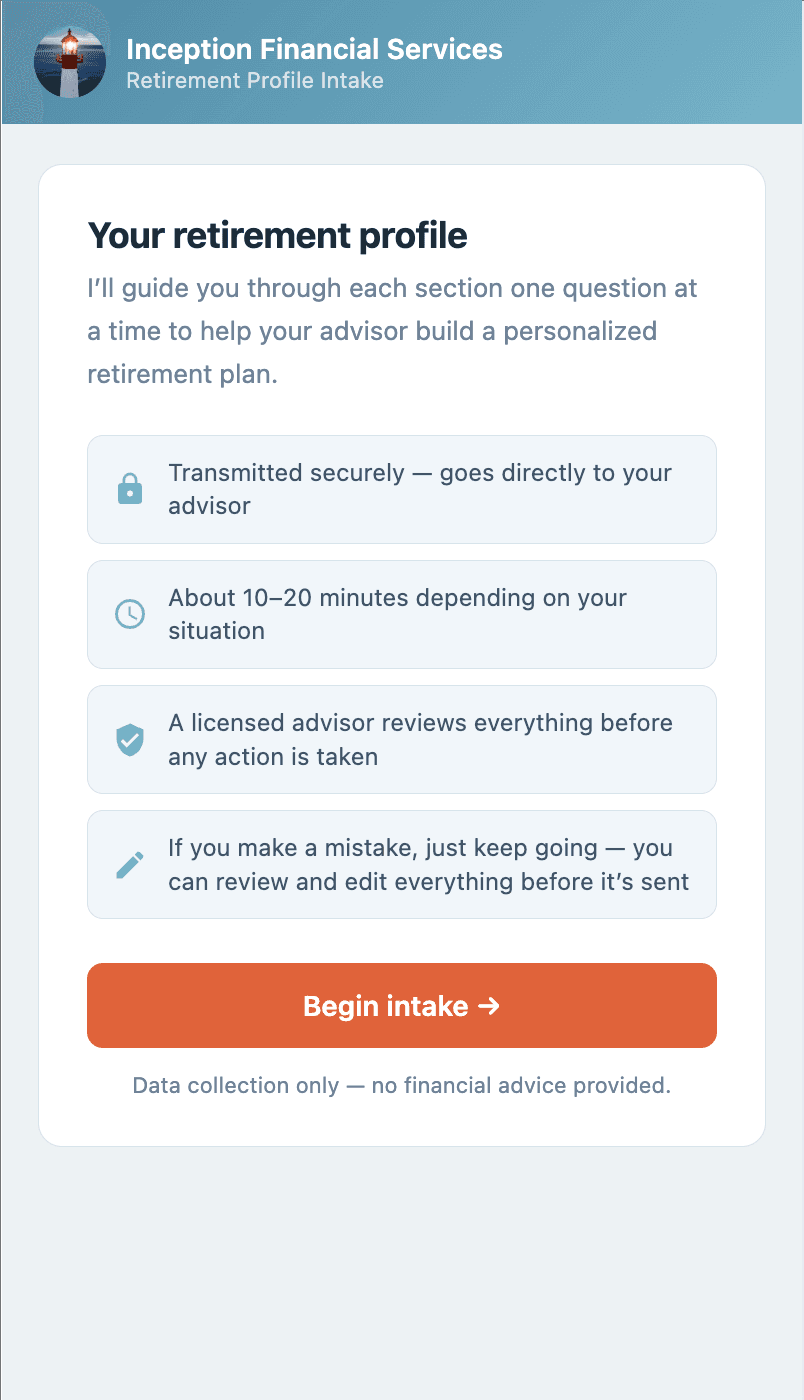
A modal at mobile viewport — with a keyboard consuming 40% of the screen — is a dead end. The CTA navigates directly to the form page. Full browser chrome available. Back button returns to the site. No friction, no trapped state.
Post-Seminar Landing Page
A page that earns the form, not just hosts it.
For seminar attendees following up by email, a dedicated landing page contextualizes the intake before asking for it — bridging the seminar and the first advisor meeting. Three steps explain the process. The form opens via modal on desktop, full-page on mobile. One URL. Two touchpoints. Same seamless experience.
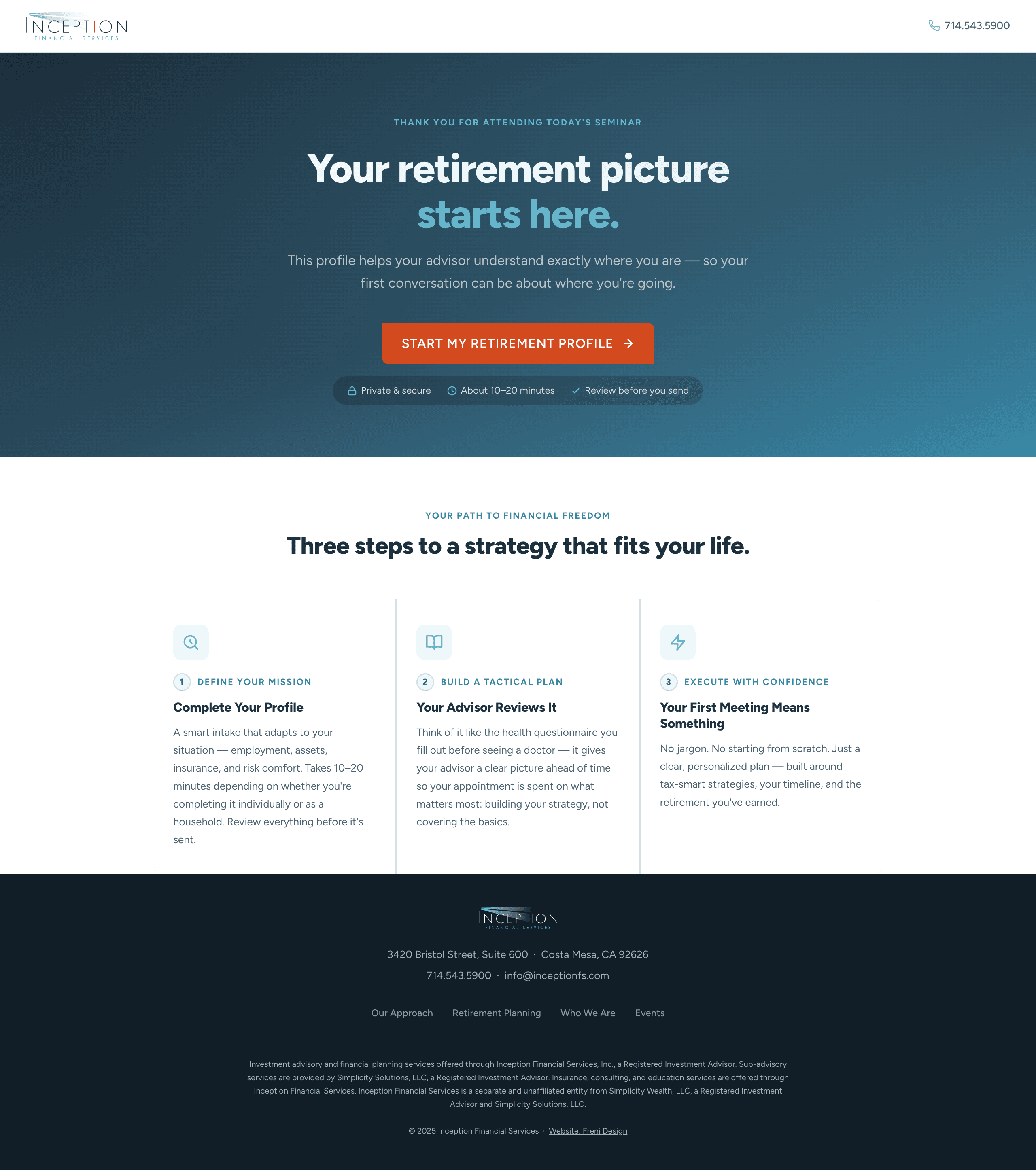
9+
Sections — conditionally rendered based on each client's actual situation
3
Delivery surfaces — website desktop, website mobile, post-seminar page
0
Redundant questions asked — the form only surfaces what applies
Reflection
The hardest part of this project was resisting the easy version. A shorter form — fewer questions, simpler sections — would have been faster to build and easier to explain. It also would have been the wrong answer. Inception's advisors need complete profiles. The problem wasn't the questions. It was the indifference to context.
The real design work happened before any interface existed: mapping the full decision tree, identifying every branch, and specifying the auto-population logic that would make the form feel intelligent rather than just brief. That specification — not the visual design — was the artifact that mattered. Once the logic was right, the interface followed naturally.
The delivery architecture was equally deliberate. Modal versus full-page isn't a preference — it's a function of viewport, keyboard behavior, and what the user can recover from if something goes wrong. Getting that wrong at mobile would have undermined everything the form's intelligence was trying to accomplish.
The intake is where the advisor relationship begins. When it's built to respect the client's time and situation, the first meeting starts from a different place — less catch-up, more strategy. That's the outcome no metric captures easily. But every advisor who opens a clean, complete profile before a meeting knows exactly what it's worth.